|
1. What is the difference between ADSB-MU4 and ADSB-MU2?
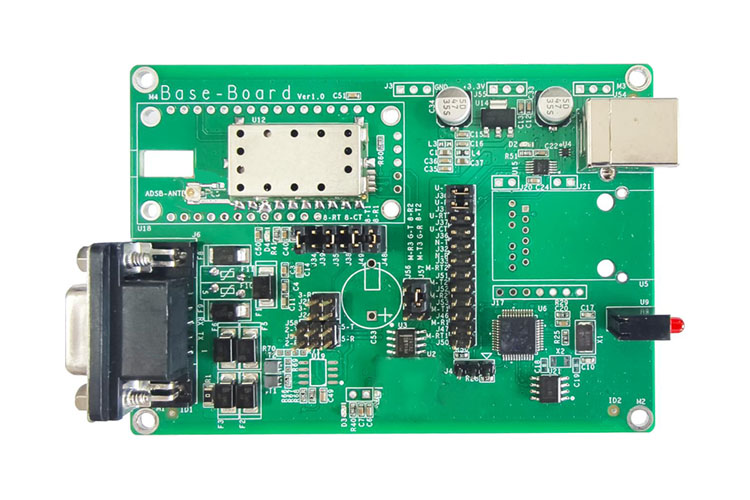
ADSB-MU4 is an upgraded high-performance version compared with ADSB-MU2.
The main differences are:
| Feature |
ADSB-MU2 |
ADSB-MU4 |
| ADS-B/Mode-S reception |
Yes |
Yes |
| Raw DF17/DF18 output |
Yes |
Yes |
| Raw Mode-S message output |
Limited |
Yes |
| High-precision timestamp |
No |
Yes |
| MLAT support |
No |
Yes |
| GNSS module |
No |
Integrated |
| Receiving sensitivity |
≤ -90dBm |
≤ -105dBm |
| Dynamic range |
Standard |
≥110 dB |
| Target capacity |
>300 targets |
>750 targets |
| Processing Capability |
> 1,500 messages/s |
> 4,000 messages/s |
| RSSI output |
No |
Optional calibrated RSSI output |
| Data Interfaces |
USB、RS232、RS485(Optional) |
USB、RS232(Optional)、RS485(Optional) |
ADSB-MU2 is designed for basic ADS-B data acquisition and embedded applications, while ADSB-MU4 is designed for applications requiring higher performance, precise timing, and advanced surveillance capabilities.
2. Can ADSB-MU4 be used for MLAT systems?
Yes. ADSB-MU4 can support MLAT (Multilateration) applications.
Unlike basic ADS-B receiver modules that only output raw ADS-B messages without timing information, ADSB-MU4 provides GPS/BDS-based high-precision timestamps for received Mode-S/ADS-B messages.
The timestamp information allows an MLAT server to calculate the time difference of arrival (TDOA) between multiple receiving stations, which is essential for aircraft position calculation.
When connected to a GNSS antenna, ADSB-MU4 provides nanosecond-level timestamp resolution and high-accuracy timing performance, making it suitable for MLAT and other time-sensitive surveillance applications.
3. Does ADSB-MU4 support ADS-B message decoding?
No.
By default, ADSB-MU4 is designed as a high-performance raw data receiver module. It receives and outputs raw Mode-S messages, including ADS-B messages, allowing external software or systems to perform further decoding and processing.
Currently, the standard version does not output decoded ADS-B data. However, decoded ADS-B message output can be provided as a customized option according to customer requirements.
This flexibility allows ADSB-MU4 to be adapted for different OEM and system integration applications. Depending on the specific requirements, customized data formats, output interfaces, and decoding functions can also be developed for integration into specialized aviation surveillance systems.
4. What applications can ADSB-MU4 be used for?
ADSB-MU4 is suitable for various embedded and professional aviation applications, including:
· MLAT (Multilateration) systems
· ADS-B ground stations
· Airport surveillance systems
· UAV/drone traffic monitoring systems
· UTM (Unmanned Traffic Management) platforms
· Flight tracking systems
· Aviation research and testing systems
· ADS-B data collection networks
· Customized aviation surveillance equipment
5. Does ADSB-MU4 provide signal strength information?
Yes. ADSB-MU4 supports optional calibrated RSSI (Received Signal Strength Indicator) output.
The signal strength can be provided in dBm units, allowing system developers to evaluate received signal quality, perform RF environment analysis, and support advanced ADS-B monitoring applications.
6. Can ADSB-MU4 be customized for OEM applications?
Yes. ADSB-MU4 supports customization for OEM and system integration applications.
Customization options include:
· Customized mechanical design
· Customized enclosure
· Customized branding and logo
· Customized data interfaces
· Customized serial communication protocols
· Customized software and functionality
AvionixTech provides flexible OEM solutions for aviation equipment manufacturers, system integrators, and research organizations.
|


 ADS-B Receiver Module ADSB-MU4 User Manual